76ers vs Detroit Pistons Match Player Stats: Complete Game Analysis (12th March, 2026

Game Recap and Final Score
The 76ers vs Detroit Pistons match player stats from Thursday, March 12, 2026 tell the story of a high-energy NBA contest that ultimately turned into a dominant home win for Detroit. Playing in front of a packed crowd at Little Caesars Arena, the Pistons delivered a strong offensive performance and defeated the Philadelphia 76ers 131-109.
Detroit controlled the rhythm of the game with efficient shooting and balanced scoring across the lineup. While the 76ers had a few solid individual performances, they struggled to keep pace defensively as the Detroit Pistons consistently found open shots and capitalized on transition opportunities.
Match Information
| Detail | Information |
|---|---|
| Match | Philadelphia 76ers vs Detroit Pistons |
| Date | Thursday, March 12, 2026 |
| Time | 4:00 AM |
| Venue | Little Caesars Arena, Detroit, MI |
| Officials | Tony Brothers, Nick Buchert, JD Ralls |
| Attendance | 20,062 |
| Final Score | Detroit Pistons 131 – Philadelphia 76ers 109 |
Team Performance & Game Insights
Detroit Pistons
Detroit’s performance felt like a complete team effort from the opening quarter. The Pistons shot an impressive 53.9% from the field and moved the ball extremely well, finishing the game with 37 assists. Their spacing on offense allowed shooters like Duncan Robinson and Javonte Green to find rhythm early.
Cade Cunningham orchestrated the offense brilliantly with 13 assists, constantly finding teammates in scoring positions. Detroit also dominated the rebounding battle and controlled the pace, which helped them build momentum through the third quarter. The team’s balanced scoring is a trend often highlighted on NBA Stats Time when analyzing efficient modern NBA offenses.
Philadelphia 76ers
Philadelphia showed flashes of offensive efficiency but struggled with consistency throughout the game. The team shot 46.7% from the field, yet their perimeter shooting was a major issue as they finished 8-for-35 from three-point range (22.9%).
Players like MarJon Beauchamp and Jabari Walker provided scoring bursts, but the team lacked sustained offensive runs. Turnovers and defensive lapses allowed Detroit to stretch the lead during the second half. Games like this highlight the importance of lineup balance often discussed in detailed match player stats breakdowns.
Quarter-by-Quarter Score Breakdown
| Team | Q1 | Q2 | Q3 | Q4 | Final |
|---|---|---|---|---|---|
| PHI | 27 | 33 | 21 | 28 | 109 |
| DET | 36 | 33 | 35 | 27 | 131 |
Individual Player Stats From the Game
A closer look at the 76ers vs Detroit Pistons match player stats shows how Detroit’s balanced scoring made the difference. Multiple Pistons players reached double figures, while Philadelphia relied on a few key contributors. Below are the complete player box score statistics from the official game record.
Detroit Pistons Player Stats
| Player | Pos | PTS | MIN | FGM | FGA | FG% | 3PM | 3PA | 3P% | FTM | FTA | FT% | OREB | DREB | REB | AST | STL | BLK | TO | PF | +/- |
|---|---|---|---|---|---|---|---|---|---|---|---|---|---|---|---|---|---|---|---|---|---|
| Duncan Robinson | F | 19 | 24:44 | 7 | 10 | 70.0 | 5 | 7 | 71.4 | 0 | 0 | 0.0 | 0 | 2 | 2 | 4 | 1 | 0 | 1 | 0 | 18 |
| Javonte Green | F | 17 | 19:01 | 5 | 8 | 62.5 | 4 | 6 | 66.7 | 3 | 3 | 100 | 1 | 1 | 2 | 1 | 3 | 0 | 0 | 1 | 20 |
| Ronald Holland II | F | 15 | 25:10 | 4 | 7 | 57.1 | 0 | 3 | 0.0 | 7 | 7 | 100 | 1 | 2 | 3 | 0 | 1 | 0 | 4 | 3 | -7 |
| Tobias Harris | F | 15 | 21:40 | 6 | 11 | 54.5 | 2 | 3 | 66.7 | 1 | 1 | 100 | 1 | 4 | 5 | 2 | 1 | 0 | 1 | 2 | 18 |
| Jalen Duren | C | 14 | 14:51 | 6 | 7 | 85.7 | 0 | 0 | 0.0 | 2 | 3 | 66.7 | 3 | 7 | 10 | 2 | 0 | 1 | 0 | 4 | 21 |
| Isaiah Stewart | C | 13 | 20:47 | 5 | 5 | 100 | 0 | 0 | 0.0 | 3 | 3 | 100 | 0 | 5 | 5 | 4 | 0 | 2 | 2 | 4 | 9 |
| Kevin Huerter | G | 12 | 26:12 | 4 | 13 | 30.8 | 2 | 7 | 28.6 | 2 | 2 | 100 | 2 | 2 | 4 | 4 | 2 | 0 | 0 | 1 | 7 |
| Marcus Sasser | G | 6 | 22:31 | 2 | 9 | 22.2 | 1 | 4 | 25.0 | 1 | 1 | 100 | 0 | 0 | 0 | 3 | 0 | 0 | 1 | 1 | 23 |
| Daniss Jenkins | G | 6 | 19:37 | 3 | 5 | 60.0 | 0 | 1 | 0.0 | 0 | 0 | 0.0 | 0 | 2 | 2 | 3 | 0 | 1 | 3 | 1 | -5 |
| Paul Reed | F | 6 | 12:22 | 3 | 5 | 60.0 | 0 | 0 | 0.0 | 0 | 0 | 0.0 | 2 | 0 | 2 | 1 | 0 | 2 | 1 | 1 | -8 |
| Cade Cunningham | G | 8 | 28:23 | 3 | 6 | 50.0 | 0 | 2 | 0.0 | 2 | 2 | 100 | 0 | 5 | 5 | 13 | 2 | 1 | 4 | 1 | 27 |
| Chaz Lanier | G | 0 | 4:42 | 0 | 3 | 0.0 | 0 | 2 | 0.0 | 0 | 0 | 0.0 | 0 | 0 | 0 | 0 | 0 | 0 | 0 | 1 | -13 |
Bench Efficiency for the Detroit
Detroit’s depth played a huge role in the victory. Javonte Green, Ronald Holland II, and Isaiah Stewart provided efficient scoring and defensive presence. Their bench rotation maintained the tempo whenever starters rested, helping the Pistons sustain offensive pressure throughout the game.
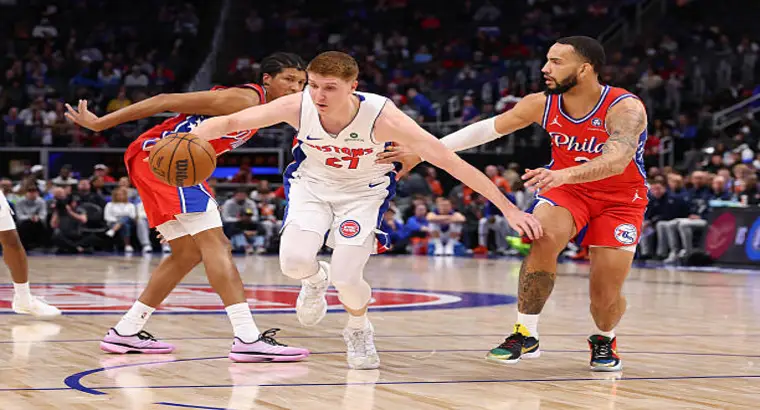
Philadelphia 76ers Player Stats
| Player | Pos | PTS | MIN | FGM | FGA | FG% | 3PM | 3PA | 3P% | FTM | FTA | FT% | OREB | DREB | REB | AST | STL | BLK | TO | PF | +/- |
|---|---|---|---|---|---|---|---|---|---|---|---|---|---|---|---|---|---|---|---|---|---|
| MarJon Beauchamp | G | 17 | 30:56 | 7 | 13 | 53.8 | 2 | 7 | 28.6 | 1 | 1 | 100 | 1 | 5 | 6 | 2 | 0 | 1 | 1 | 3 | -1 |
| Jabari Walker | F | 16 | 18:18 | 6 | 6 | 100 | 2 | 2 | 100 | 2 | 2 | 100 | 1 | 0 | 1 | 2 | 0 | 0 | 2 | 2 | -5 |
| Cameron Payne | G | 15 | 18:32 | 5 | 10 | 50.0 | 2 | 6 | 33.3 | 3 | 4 | 75.0 | 0 | 1 | 1 | 2 | 0 | 0 | 2 | 1 | -9 |
| Quentin Grimes | G | 14 | 32:04 | 5 | 14 | 35.7 | 1 | 8 | 12.5 | 3 | 6 | 50.0 | 2 | 1 | 3 | 5 | 1 | 1 | 3 | 0 | -28 |
| Justin Edwards | F | 12 | 29:20 | 5 | 11 | 45.5 | 0 | 2 | 0.0 | 2 | 4 | 50.0 | 3 | 6 | 9 | 5 | 4 | 0 | 1 | 2 | -5 |
| Dominick Barlow | C | 11 | 26:25 | 5 | 10 | 50.0 | 1 | 3 | 33.3 | 0 | 0 | 0.0 | 1 | 3 | 4 | 0 | 2 | 1 | 1 | 4 | -16 |
| VJ Edgecombe | G | 10 | 29:12 | 3 | 14 | 21.4 | 0 | 5 | 0.0 | 4 | 4 | 100 | 2 | 3 | 5 | 0 | 0 | 2 | 3 | 0 | -19 |
| Dalen Terry | G | 8 | 22:40 | 3 | 6 | 50.0 | 0 | 1 | 0.0 | 2 | 3 | 66.7 | 0 | 3 | 3 | 2 | 0 | 2 | 1 | 3 | 1 |
| Trendon Watford | F | 4 | 19:39 | 2 | 5 | 40.0 | 0 | 1 | 0.0 | 0 | 0 | 0.0 | 0 | 2 | 2 | 1 | 1 | 1 | 1 | 0 | -20 |
| Tyrese Martin | G | 2 | 8:43 | 1 | 1 | 100 | 0 | 0 | 0.0 | 0 | 0 | 0.0 | 1 | 0 | 1 | 1 | 2 | 0 | 0 | 1 | 2 |
| Kyle Lowry | G | 0 | 4:11 | 0 | 0 | 0.0 | 0 | 0 | 0.0 | 0 | 0 | 0.0 | 0 | 0 | 0 | 0 | 0 | 0 | 0 | 1 | -10 |
Bench Efficiency for the Philadelphia
Philadelphia’s bench tried to keep the game competitive, particularly through Jabari Walker and Cameron Payne, who provided efficient scoring in limited minutes. However, the team struggled to slow Detroit’s offensive flow, which made it difficult to cut into the deficit during the second half.
Fans looking to compare performances can also explore how Philadelphia performed in the previous Denver Nuggets vs 76ers match player stats, which revealed a very different game flow and outcome.
Match Stats Comparison of Both Teams
| Category | 76ers | Pistons |
|---|---|---|
| Field Goals | 42-90 | 48-89 |
| Field Goal % | 46.7% | 53.9% |
| Three Pointers | 8-35 | 14-35 |
| Three Point % | 22.9% | 40.0% |
| Free Throws | 17-24 | 21-22 |
| Total Rebounds | 35 | 40 |
| Assists | 20 | 37 |
| Steals | 10 | 10 |
| Blocks | 8 | 7 |
| Turnovers | 15 | 17 |
Detroit Piston’s advantage in shooting efficiency and ball movement clearly shaped the final result. The Pistons’ 37 assists highlighted strong team chemistry, while Philadelphia struggled to convert perimeter opportunities.
Injury Report
| Team | Player | Position | Status | Injury | Expected Return |
|---|---|---|---|---|---|
| DET | Bobi Klintman | F | Out | Coach’s Decision – Not Specified | 2026-03-13 |
| DET | Caris LeVert | G | Out | Wrist – Sprain | 2026-03-13 |
| DET | Ausar Thompson | G | Out | Ankle – Sprain | 2026-03-13 |
| PHI | Andre Drummond | C | Out | Back – Spasms | 2026-03-14 |
| PHI | Adem Bona | C | Out | Back – Soreness | 2026-03-14 |
| PHI | Kelly Oubre Jr. | G | Out | Elbow – Sprain | 2026-03-28 |
| PHI | Tyrese Maxey | G | Out | Finger – Sprain | 2026-04-01 |
| PHI | Joel Embiid | C | Out | Oblique – Strain | 2026-03-14 |
Complete PDF of This Match Stats
FAQs
Who won the 76ers vs Detroit Pistons game on March 12, 2026?
The Detroit Pistons defeated the Philadelphia 76ers 131-109 at Little Caesars Arena, delivering a strong offensive performance and efficient shooting throughout the game.
Who was the top scorer in the game?
Duncan Robinson led Detroit with 19 points, showcasing excellent three-point shooting efficiency during the matchup.
How many assists did Cade Cunningham record?
Cade Cunningham finished the game with 13 assists, playing a major role in Detroit’s offensive playmaking.
Which 76ers player scored the most points?
MarJon Beauchamp led Philadelphia with 17 points, followed by Jabari Walker who added 16 points on perfect shooting.
How did Detroit dominate the game statistically?
Detroit shot 53.9% from the field and recorded 37 assists, showing excellent offensive execution and ball movement.
What was the key turning point in the game?
Detroit’s strong third quarter, where they scored 35 points, helped extend the lead and put the game out of reach for Philadelphia.
Final Thoughts
The 76ers vs Detroit Pistons match player stats show how Detroit’s efficiency on both ends of the floor shaped the result. Strong shooting, disciplined defense, and consistent ball movement helped the Pistons pull away and finish with a comfortable victory.