Portland Trail Blazers vs Utah Jazz Match Player Stats (13th March, 2026)

Quick Overview of the Blazers vs Jaz Matchup
The Portland Trail Blazers vs Utah Jazz Match Player Stats clash started with Utah setting the tone early, but the game quickly shifted once Portland found its rhythm. After a slow first quarter, the Blazers responded with a dominant second quarter that completely changed the flow of the game and set them up for a 124–114 victory.
From that point on, Portland controlled the tempo with smarter ball movement and stronger defensive presence. Utah had its scoring bursts, but Portland’s consistency across all four quarters made the real difference in this matchup.
Match Information
- Date & Day: Friday, March 13th, 2026
- Time: 7:00 AM
- Venue: Moda Center, Portland, OR
- Officials: CJ Washington, James Williams, Ashley Moyer-Gleich
- Attendance: 17,352
- Final Score: Portland Trail Blazers 124 – Utah Jazz 114
Team Performance & Key Insights
Portland Trail Blazers Performance
Portland looked shaky early, but once they settled into their offensive sets, the game tilted in their favor. The team shot an impressive 51.7% from the field and moved the ball well, finishing with 34 assists. Their ability to stretch the floor with 17 made threes created consistent pressure on Utah’s defense.
Players like Jrue Holiday and Scoot Henderson controlled the tempo, while Donovan Clingan dominated inside with rebounds and rim protection. This performance mirrors what we’ve already seen in Portland’s strong offensive rhythm against lakers, showing their growing consistency.
Utah Jazz Performance
Utah started strong with a 38-point opening quarter, showcasing efficient shooting and aggressive playmaking. Brice Sensabaugh led the scoring charge with elite efficiency, and the team overall shot 45.7% from the field with a solid 43.3% from three-point range. However, turnovers (18 total) and defensive lapses in the second quarter shifted the momentum.
Quarter By Quarter Breakdown
| Team | Q1 | Q2 | Q3 | Q4 | Final |
|---|---|---|---|---|---|
| UTA | 38 | 20 | 31 | 25 | 114 |
| POR | 28 | 38 | 29 | 29 | 124 |
Individual Player Stats Breakdown
This section covers the complete Portland Trail Blazers vs Utah Jazz Match Player Stats, focusing on individual contributions from both sides. All player performances are listed based on official boxscore data, highlighting scoring impact and overall efficiency in this game.
Portland Trail Blazers Player Stats
| Player | Pos | PTS | MIN | FGM | FGA | FG% | 3PM | 3PA | 3P% | FTM | FTA | FT% | OREB | DREB | REB | AST | STL | BLK | TO | PF | +/- |
|---|---|---|---|---|---|---|---|---|---|---|---|---|---|---|---|---|---|---|---|---|---|
| Jrue Holiday | G | 25 | 31:59 | 10 | 16 | 62.5 | 4 | 9 | 44.4 | 1 | 2 | 50.0 | 0 | 5 | 5 | 8 | 1 | 1 | 3 | 0 | 10 |
| Scoot Henderson | G | 25 | 29:55 | 8 | 14 | 57.1 | 5 | 7 | 71.4 | 4 | 4 | 100 | 1 | 4 | 5 | 3 | 0 | 1 | 5 | 2 | 11 |
| Donovan Clingan | C | 21 | 35:03 | 7 | 12 | 58.3 | 1 | 3 | 33.3 | 6 | 6 | 100 | 5 | 10 | 15 | 2 | 3 | 6 | 1 | 1 | 20 |
| Deni Avdija | G | 17 | 32:11 | 7 | 9 | 77.8 | 0 | 2 | 0.0 | 3 | 3 | 100 | 2 | 4 | 6 | 8 | 2 | 1 | 5 | 3 | 0 |
| Sidy Cissoko | F | 14 | 17:23 | 6 | 10 | 60.0 | 2 | 5 | 40.0 | 0 | 0 | 0.0 | 1 | 3 | 4 | 2 | 1 | 1 | 1 | 1 | 10 |
| Jerami Grant | F | 9 | 25:20 | 3 | 5 | 60.0 | 2 | 4 | 50.0 | 1 | 1 | 100 | 1 | 2 | 3 | 0 | 0 | 0 | 4 | 2 | -17 |
| Matisse Thybulle | G | 6 | 14:58 | 2 | 8 | 25.0 | 2 | 6 | 33.3 | 0 | 0 | 0.0 | 0 | 1 | 1 | 1 | 4 | 1 | 1 | 3 | 0 |
| Toumani Camara | F | 5 | 22:48 | 2 | 10 | 20.0 | 1 | 7 | 14.3 | 0 | 0 | 0.0 | 0 | 4 | 4 | 3 | 3 | 0 | 1 | 5 | 12 |
| Vít Krejčí | G | 2 | 15:01 | 1 | 3 | 33.3 | 0 | 2 | 0.0 | 0 | 0 | 0.0 | 3 | 0 | 3 | 5 | 1 | 0 | 2 | 1 | 18 |
| Kris Murray | F | 0 | 13:44 | 0 | 2 | 0.0 | 0 | 1 | 0.0 | 0 | 0 | 0.0 | 1 | 2 | 3 | 2 | 1 | 1 | 1 | 0 | -8 |
| Blake Wesley | G | 0 | 0:49 | 0 | 0 | 0.0 | 0 | 0 | 0.0 | 0 | 0 | 0.0 | 0 | 0 | 0 | 0 | 0 | 0 | 0 | 1 | -3 |
| Hansen Yang | C | 0 | 0:49 | 0 | 0 | 0.0 | 0 | 0 | 0.0 | 0 | 0 | 0.0 | 0 | 0 | 0 | 0 | 0 | 0 | 0 | 0 | -3 |
Bench Impact – Portland
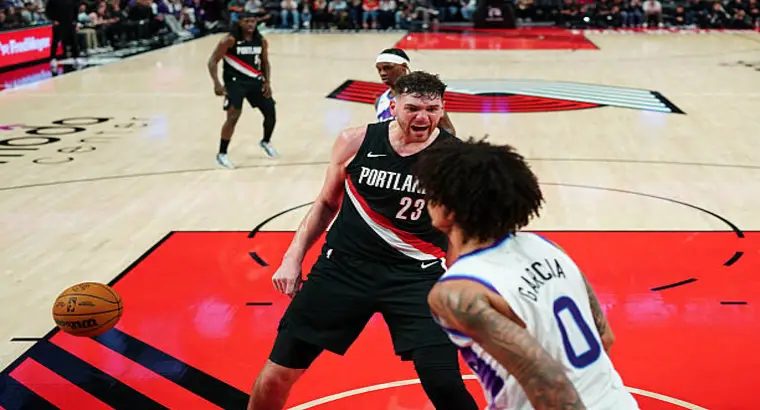
Portland’s bench made a real difference in this win. Scoot Henderson and Sidy Cissoko brought scoring bursts, while Thybulle added defensive pressure. This depth allowed Portland to maintain intensity even when starters rotated out.
Utah Jazz Player Stats
| Player | Pos | PTS | MIN | FGM | FGA | FG% | 3PM | 3PA | 3P% | FTM | FTA | FT% | OREB | DREB | REB | AST | STL | BLK | TO | PF | +/- |
|---|---|---|---|---|---|---|---|---|---|---|---|---|---|---|---|---|---|---|---|---|---|
| Brice Sensabaugh | F | 31 | 29:16 | 12 | 19 | 63.2 | 6 | 8 | 75.0 | 1 | 1 | 100 | 0 | 3 | 3 | 1 | 2 | 1 | 2 | 1 | -3 |
| Cody Williams | F | 19 | 36:26 | 7 | 17 | 41.2 | 0 | 0 | 0.0 | 5 | 7 | 71.4 | 1 | 6 | 7 | 3 | 1 | 0 | 4 | 4 | -4 |
| Isaiah Collier | G | 17 | 29:47 | 6 | 15 | 40.0 | 0 | 2 | 0.0 | 5 | 6 | 83.3 | 1 | 2 | 3 | 9 | 2 | 0 | 2 | 3 | 4 |
| Kyle Filipowski | C | 11 | 24:51 | 4 | 8 | 50.0 | 3 | 5 | 60.0 | 0 | 0 | 0.0 | 0 | 6 | 6 | 5 | 3 | 0 | 1 | 1 | 12 |
| Elijah Harkless | G | 10 | 30:03 | 2 | 8 | 25.0 | 2 | 7 | 28.6 | 4 | 6 | 66.7 | 1 | 3 | 4 | 2 | 2 | 0 | 3 | 2 | -20 |
| Ace Bailey | G | 8 | 7:16 | 3 | 3 | 100 | 2 | 2 | 100 | 0 | 0 | 0.0 | 0 | 1 | 1 | 1 | 1 | 1 | 0 | 1 | 16 |
| Oscar Tshiebwe | C | 8 | 19:58 | 4 | 8 | 50.0 | 0 | 0 | 0.0 | 0 | 0 | 0.0 | 2 | 3 | 5 | 1 | 1 | 0 | 0 | 0 | -16 |
| Andersson Garcia | F | 6 | 28:33 | 2 | 6 | 33.3 | 0 | 3 | 0.0 | 2 | 2 | 100 | 2 | 1 | 3 | 2 | 2 | 0 | 3 | 4 | -11 |
| Bez Mbeng | G | 4 | 33:50 | 2 | 8 | 25.0 | 0 | 3 | 0.0 | 0 | 0 | 0.0 | 3 | 1 | 4 | 4 | 2 | 1 | 3 | 1 | -28 |
Bench Contribution – Utah
Utah’s bench showed flashes, especially with Ace Bailey’s perfect shooting in limited minutes. However, overall impact remained inconsistent. Turnovers and defensive gaps from second-unit players allowed Portland to extend their lead.
Explore Another Jazz Match: Jazz vs Cilpeers match stats
Team Stats Comparison
| Category | Utah Jazz | Portland Trail Blazers |
|---|---|---|
| Field Goal % | 45.7% | 51.7% |
| 3-Point % | 43.3% | 37.0% |
| Free Throw % | 77.3% | 93.8% |
| Total Rebounds | 36 | 49 |
| Assists | 28 | 34 |
| Turnovers | 18 | 24 |
| Steals | 16 | 16 |
| Blocks | 3 | 12 |
| Points | 114 | 124 |
| Fouls | 17 | 19 |
Portland’s edge came from rebounding dominance and rim protection. Their 12 blocks and 49 rebounds highlight interior control, which ultimately decided the game despite Utah’s better three-point efficiency.
Portland Trail Blazers and Utah Jazz Injury Report
| Team | Player | Position | Status | Injury | Expected Return |
|---|---|---|---|---|---|
| POR | Robert Williams III | C | Day-To-Day | Knee – Not Specified | 2026-03-15 |
| POR | Chris Youngblood | G | Day-To-Day | Knee – Not Specified | 2026-03-15 |
| POR | Shaedon Sharpe | G | Out | Calf – Fracture | 2026-04-02 |
| POR | Damian Lillard | G | Out | Achilles – Surgery | 2026-10-01 |
| UTAH | John Konchar | G | Day-To-Day | Calf – Soreness | 2026-03-15 |
| UTAH | Keyonte George | G | Out | Hamstring – Strain | 2026-03-27 |
| UTAH | Lauri Markkanen | F | Out | Hip – Pinched Nerve | 2026-03-21 |
| UTAH | Jusuf Nurkic | C | Out | Nose – Surgery | 2026-10-01 |
Portland Trail Blazers vs Utah Jazz Match PDF
Frequently Asked Questions
Who won the Portland Trail Blazers vs Utah Jazz game?
The Portland Trail Blazers won the game with a final score of 124–114, overcoming an early deficit with strong second-half performance.
Who was the top scorer in the match?
Brice Sensabaugh led all scorers with 31 points, delivering an efficient offensive performance for the Utah Jazz.
How did Portland dominate the game?
Portland dominated through rebounding, assists, and defensive presence, especially with 12 blocks and strong inside scoring.
Which player had the best all-around performance?
Donovan Clingan stood out with 21 points, 15 rebounds, and 6 blocks, impacting both ends of the floor significantly.
What was the turning point of the game?
The second quarter, where Portland outscored Utah 38–20, shifted momentum completely in their favor.
How did Scoot Henderson perform?
Scoot Henderson scored 25 points with excellent efficiency, including 5 three-pointers and perfect free-throw shooting.
Did Utah Jazz perform well offensively?
Yes, Utah shot well overall, especially from three-point range, but turnovers and defense limited their chances.
What role did bench players play?
Portland’s bench contributed consistent scoring and defense, while Utah’s bench showed limited overall impact despite a few bright spots.
Final Thoughts
Portland’s performance in this game felt composed and well-structured, especially after the early setback. They didn’t rush—just adjusted, executed, and gradually took control. That kind of response says a lot about their current form.
Utah showed clear offensive potential, but small defensive gaps and momentum swings held them back. Moving forward, tightening those areas will be key if they want better results in similar matchups.
For more breakdowns like this, stay connected with NBA Stats Time and explore detailed NBA match player stats insights.