Sacramento Kings vs Phoenix Suns Match Player Stats (Latest Match Mar 03, 2026)

Sacramento Kings vs Phoenix Suns Match Summary
The Sacramento Kings vs Phoenix Suns Match Player Stats matchup on Tuesday, March 3, 2026, delivered an entertaining NBA contest at the Golden 1 Center in Sacramento, California. In front of 15,009 fans, the Phoenix Suns produced a balanced offensive performance to defeat the Sacramento Kings 114–103 in a competitive Western Conference battle.
Sacramento started strong in the opening quarter, but Phoenix adjusted quickly with efficient shooting and ball movement. The Suns eventually took control during the middle stages of the game and held their lead through the final period. Games like this continue to highlight why detailed breakdowns on NBA Stats Time help fans better understand how NBA matchups unfold through real box score data.
Team Performance Insights
Phoenix Suns Match Performance
Phoenix relied on balanced scoring and strong rebounding to secure the victory. Jalen Green led the Suns with 20 points, while Grayson Allen added 18 points and Collin Gillespie contributed 17 points with 9 assists. The Suns also dominated the boards with 53 total rebounds, including a huge 14-rebound night from Oso Ighodaro, which helped control the pace.
The Suns’ perimeter shooting played a major role in the result. Phoenix knocked down 19 three-pointers, stretching Sacramento’s defense throughout the second and third quarters.
Sacramento Kings Match Performance
Sacramento showed early momentum and won the first quarter behind strong inside scoring. Maxime Raynaud delivered the Kings’ best performance with 22 points and 10 rebounds, shooting an impressive 10-for-12 from the field. Precious Achiuwa added 18 points and 9 rebounds, while Russell Westbrook recorded 16 points and 7 assists.
However, the Kings struggled from beyond the arc, making only 7 three-pointers on 27 attempts (25.9%). That shooting gap allowed Phoenix to build a second-half lead. For more similar statistical game breakdowns across the league, readers often explore the latest NBA match player stats updates.
Quarter-by-Quarter Score Breakdown
The momentum of the game shifted after the first quarter. Sacramento opened with a strong scoring run, but Phoenix responded with a dominant second quarter that ultimately decided the outcome of the game.
| Team | Q1 | Q2 | Q3 | Q4 | Final |
|---|---|---|---|---|---|
| PHX | 22 | 37 | 31 | 24 | 114 |
| SAC | 30 | 25 | 20 | 28 | 103 |
Phoenix’s 37-point second quarter changed the direction of the game. The Suns continued the pressure in the third quarter with 31 more points, creating a comfortable lead that Sacramento could not fully recover from despite a stronger final quarter.
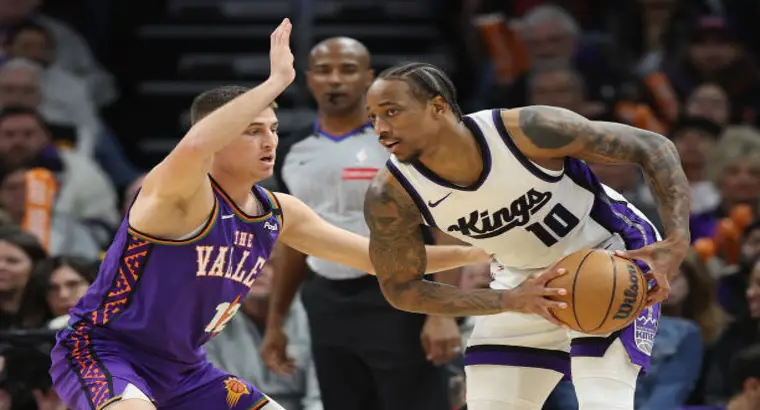
Individual Player Stats of Both Teams
The Sacramento Kings vs Phoenix Suns Match Player Stats reveal how Phoenix used balanced scoring and rebounding dominance to control the game. Several Suns players delivered efficient shooting nights, while Sacramento relied on strong frontcourt production from Maxime Raynaud and Precious Achiuwa.
Phoenix Suns Player Stats
| Player | Pos | PTS | MIN | FGM | FGA | FG% | 3PM | 3PA | 3P% | FTM | FTA | FT% | OREB | DREB | REB | AST | STL | BLK | TO | PF | +/- |
|---|---|---|---|---|---|---|---|---|---|---|---|---|---|---|---|---|---|---|---|---|---|
| Jalen Green | F | 20 | 31:01 | 7 | 16 | 43.8 | 2 | 8 | 25.0 | 4 | 4 | 100 | 0 | 4 | 4 | 1 | 4 | 1 | 7 | 1 | 8 |
| Grayson Allen | G | 18 | 25:20 | 6 | 15 | 40.0 | 4 | 12 | 33.3 | 2 | 2 | 100 | 1 | 2 | 3 | 6 | 3 | 0 | 3 | 0 | 18 |
| Devin Booker | G | 17 | 31:08 | 6 | 19 | 31.6 | 4 | 9 | 44.4 | 1 | 1 | 100 | 2 | 2 | 4 | 6 | 0 | 0 | 3 | 2 | -5 |
| Collin Gillespie | G | 17 | 31:29 | 6 | 10 | 60.0 | 5 | 8 | 62.5 | 0 | 0 | 0.0 | 2 | 3 | 5 | 9 | 1 | 0 | 2 | 2 | 15 |
| Oso Ighodaro | C | 14 | 25:48 | 7 | 10 | 70.0 | 0 | 0 | 0.0 | 0 | 2 | 0.0 | 8 | 6 | 14 | 3 | 0 | 1 | 2 | 2 | 21 |
| Mark Williams | C | 10 | 22:12 | 3 | 6 | 50.0 | 0 | 0 | 0.0 | 4 | 6 | 66.7 | 3 | 6 | 9 | 0 | 1 | 0 | 1 | 0 | -10 |
| Rasheer Fleming | F | 8 | 15:06 | 3 | 4 | 75.0 | 2 | 3 | 66.7 | 0 | 0 | 0.0 | 2 | 4 | 6 | 1 | 0 | 0 | 0 | 2 | 5 |
| Royce O’Neale | F | 6 | 28:59 | 2 | 7 | 28.6 | 2 | 7 | 28.6 | 0 | 0 | 0.0 | 0 | 4 | 4 | 5 | 2 | 1 | 1 | 4 | -7 |
| Ryan Dunn | G | 2 | 16:49 | 1 | 2 | 50.0 | 0 | 1 | 0.0 | 0 | 2 | 0.0 | 0 | 1 | 1 | 0 | 0 | 0 | 0 | 0 | 13 |
| Amir Coffey | F | 2 | 12:08 | 1 | 3 | 33.3 | 0 | 1 | 0.0 | 0 | 0 | 0.0 | 0 | 3 | 3 | 0 | 0 | 0 | 0 | 0 | -3 |
Bench Contribution – Phoenix Suns
Phoenix Suns received solid production from the bench unit. Grayson Allen scored 18 points, while Oso Ighodaro delivered a major impact with 14 rebounds and 14 points. Additional support from Rasheer Fleming and Ryan Dunn helped maintain energy during rotation minutes.
Sacramento Kings Player Stats
| Player | Pos | PTS | MIN | FGM | FGA | FG% | 3PM | 3PA | 3P% | FTM | FTA | FT% | OREB | DREB | REB | AST | STL | BLK | TO | PF | +/- |
|---|---|---|---|---|---|---|---|---|---|---|---|---|---|---|---|---|---|---|---|---|---|
| Maxime Raynaud | C | 22 | 35:56 | 10 | 12 | 83.3 | 0 | 0 | 0.0 | 2 | 3 | 66.7 | 4 | 6 | 10 | 4 | 2 | 0 | 3 | 4 | 3 |
| Precious Achiuwa | F | 18 | 38:57 | 8 | 14 | 57.1 | 0 | 2 | 0.0 | 2 | 2 | 100 | 3 | 6 | 9 | 1 | 1 | 1 | 0 | 1 | 0 |
| DeMar DeRozan | F | 17 | 33:36 | 5 | 15 | 33.3 | 0 | 2 | 0.0 | 7 | 9 | 77.8 | 0 | 2 | 2 | 1 | 0 | 0 | 1 | 1 | -14 |
| Russell Westbrook | G | 16 | 31:28 | 6 | 14 | 42.9 | 3 | 6 | 50.0 | 1 | 2 | 50.0 | 0 | 2 | 2 | 7 | 4 | 1 | 3 | 2 | -2 |
| Malik Monk | G | 13 | 17:51 | 5 | 10 | 50.0 | 3 | 7 | 42.9 | 0 | 0 | 0.0 | 1 | 2 | 3 | 5 | 0 | 0 | 4 | 0 | -19 |
| Nique Clifford | G | 10 | 39:19 | 5 | 13 | 38.5 | 0 | 5 | 0.0 | 0 | 0 | 0.0 | 2 | 6 | 8 | 4 | 3 | 0 | 2 | 3 | 5 |
| Killian Hayes | G | 3 | 9:51 | 1 | 4 | 25.0 | 1 | 3 | 33.3 | 0 | 0 | 0.0 | 0 | 0 | 0 | 2 | 0 | 0 | 0 | 0 | -3 |
| Daeqwon Plowden | F | 2 | 20:58 | 0 | 3 | 0.0 | 0 | 2 | 0.0 | 2 | 2 | 100 | 1 | 3 | 4 | 1 | 0 | 0 | 0 | 1 | -11 |
| Devin Carter | G | 2 | 9:25 | 1 | 4 | 25.0 | 0 | 0 | 0.0 | 0 | 0 | 0.0 | 2 | 0 | 2 | 0 | 1 | 0 | 0 | 1 | -7 |
| Drew Eubanks | C | 0 | 2:39 | 0 | 1 | 0.0 | 0 | 0 | 0.0 | 0 | 0 | 0.0 | 0 | 0 | 0 | 0 | 0 | 0 | 1 | 1 | -7 |
Bench Impact – Sacramento Kings
Sacramento’s bench showed flashes but lacked consistent scoring. Malik Monk led the reserve unit with 13 points, while Killian Hayes and Devin Carter provided limited offensive production. The Kings’ bench ultimately could not match Phoenix’s depth.
Team Stats Comparison
| Statistic | Phoenix Suns | Sacramento Kings |
|---|---|---|
| Field Goals | 42-92 (45.7%) | 41-90 (45.6%) |
| 3-Pointers | 19-49 (38.8%) | 7-27 (25.9%) |
| Free Throws | 11-17 (64.7%) | 14-18 (77.8%) |
| Total Rebounds | 53 | 40 |
| Assists | 31 | 25 |
| Steals | 11 | 11 |
| Blocks | 3 | 2 |
| Turnovers | 19 | 14 |
| Personal Fouls | 13 | 14 |
| Total Points | 114 | 103 |
Phoenix’s advantage from three-point range played a major role in the final result. The Suns hit 12 more three-pointers than Sacramento, which helped offset their higher turnover total. Their rebounding dominance also created second-chance opportunities.
For a deeper comparison of other NBA contest, explore detailed breakdown of Portland Trail Blazers vs Utah Jazz player stats to track evolving trends across games.
Sacramento Kings vs Phoenix Suns Latest Head to Head Matches
| Date | Winner | Score | Venue |
|---|---|---|---|
| Mar 3, 2026 | Suns | 114–103 | Sacramento |
| Jan 2, 2026 | Suns | 129–102 | Phoenix |
| Nov 26, 2025 | Suns | 112–100 | Sacramento |
| Oct 22, 2025 | Suns | 120–116 | Phoenix |
| Apr 13, 2025 | Kings | 109–98 | Sacramento |
| Mar 14, 2025 | Suns | 122–106 | Phoenix |
| Nov 13, 2024 | Kings | 127–104 | Sacramento |
| Nov 10, 2024 | Kings | 127–118 (OT) | Phoenix |
| Apr 12, 2024 | Suns | 108–107 | Sacramento |
| Feb 13, 2024 | Suns | 130–125 | Phoenix |
FAQs
1. Who scored the most points in the Sacramento Kings vs Phoenix Suns match?
Jalen Green led all Phoenix Suns players with 20 points, making 7 of his 16 field-goal attempts. For Sacramento, Maxime Raynaud led the team with 22 points on an efficient shooting night.
2. What was the final score of the Suns vs Kings game on March 3, 2026?
The Phoenix Suns defeated the Sacramento Kings 114–103 at the Golden 1 Center in Sacramento during this NBA matchup.
3. Which player recorded the most rebounds in the game?
Oso Ighodaro grabbed 14 rebounds for Phoenix, the highest total in the game, helping the Suns dominate the rebounding battle.
4. How did Russell Westbrook perform in the game?
Russell Westbrook finished with 16 points, 7 assists, and 4 steals, providing playmaking and defensive activity for Sacramento.
5. Which team shot better from three-point range?
Phoenix clearly had the edge from deep, making 19 three-pointers on 49 attempts (38.8%), compared to Sacramento’s 7-of-27 shooting (25.9%).
6. Where was the Kings vs Suns game played?
The game took place at Golden 1 Center in Sacramento, California, with an attendance of 15,009 fans.
7. Which Sacramento player had the most efficient shooting night?
Maxime Raynaud had the most efficient performance, shooting 10-for-12 from the field while scoring 22 points.
Final Thoughts
The Sacramento Kings vs Phoenix Suns Match highlight how Phoenix used depth, rebounding, and perimeter shooting to secure the victory. The Suns’ balanced offense and strong second quarter ultimately created a gap Sacramento could not overcome.
While the Kings showed strong individual performances from Raynaud and Achiuwa, Phoenix’s overall team execution proved decisive. Games like this continue to demonstrate the importance of shooting efficiency and rebounding in modern NBA matchups.